What Is Dementia Care? How Dementia Care Is Different From Standard Elderly Care

Dementia care is specialist support designed for people living with dementia, including conditions such as Alzheimer’s disease, vascular dementia, and Lewy body dementia.

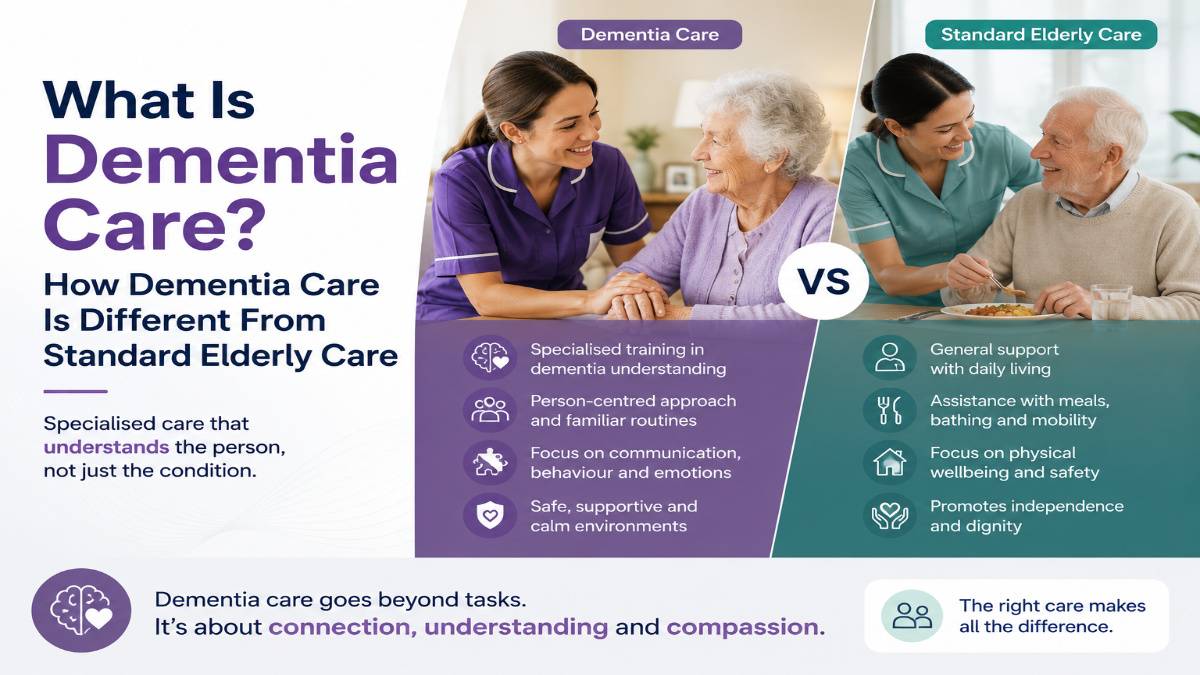
Unlike standard elderly care, dementia care focuses not only on physical support but also on memory, behaviour, communication, safety, and emotional wellbeing.

As dementia progresses, many people need increasing levels of supervision and structured support to remain safe and maintain quality of life.

Families often begin researching dementia care after noticing:

  • memory problems
  • confusion
  • wandering
  • behavioural changes
  • difficulty managing daily routines

If you are noticing these changes in a loved one, our guide on 10 signs your elderly parent needs help explains the early warning signs families commonly experience.

What Does Dementia Care Include

The level of dementia support depends on the stage of the condition and the person’s individual needs.

Personal care support

Dementia care often includes help with:

  • washing and dressing
  • eating and nutrition
  • medication support
  • mobility assistance
  • daily routines

As memory problems progress, many people find ordinary daily tasks increasingly difficult to manage independently.

Memory and cognitive support

One of the biggest differences between standard elderly care and dementia care is cognitive support.

Dementia carers are trained to help with:

  • memory confusion
  • repetitive behaviour
  • disorientation
  • communication difficulties
  • anxiety and distress

Support is usually structured around familiar routines to reduce confusion and improve reassurance.

Safety and supervision

People living with dementia may become vulnerable to:

  • falls
  • wandering
  • medication mistakes
  • leaving appliances on
  • confusion outside the home

Dementia care environments are designed to improve safety while helping residents maintain independence where possible.

According to the NHS, people living with dementia may need increasing support with daily living and personal safety as symptoms progress. (nhs.uk)

How Dementia Care Is Different From Standard Residential Care

Many families are unsure about the difference between residential care and dementia care.

Residential care focuses mainly on daily living support

Standard residential care usually supports:

  • older adults needing help with daily tasks
  • mobility support
  • meals and personal care
  • social interaction and companionship

If you are unfamiliar with residential care itself, our guide on what is residential care explains how residential support works in the UK.

Dementia care provides specialist cognitive support

Dementia care includes everything residential care offers, but with additional specialist support for memory-related conditions.

This may include:

  • dementia-trained staff
  • secure environments
  • structured routines
  • behavioural support
  • enhanced supervision

Families exploring dementia care homes UK are often looking for environments specifically designed to support cognitive decline safely and compassionately.

What Are Dementia Care Homes

Dementia care homes are specialist care settings designed for people living with dementia.

What dementia care homes provide

Specialist dementia care homes may offer:

  • 24 hour support
  • memory-focused care plans
  • secure layouts
  • dementia-friendly activities
  • specialist behavioural support

The goal is to create a safe, calm, and familiar environment that reduces stress and confusion.

When someone may need dementia care

A person may need specialist dementia support if they:

  • frequently become confused
  • wander or become disoriented
  • struggle with personal safety
  • forget medication regularly
  • show significant behavioural changes

As symptoms progress, living safely at home can become increasingly difficult.

Dementia Care Services in the UK

Dementia support can be provided in different ways depending on individual needs.

Home dementia care services

Some people receive dementia support at home through carers visiting regularly.

This may help during earlier stages of dementia when independent living is still possible with assistance.

Residential dementia care

Residential dementia care provides full time support within a care home environment.

Families may explore specialist support such as:

Choosing the right dementia care environment often depends on:

  • stage of dementia
  • medical needs
  • supervision required
  • family location
  • social support needs

Why Dementia Care Requires Specialist Training

Supporting someone with dementia is very different from standard elderly care.

Communication challenges

People living with dementia may:

  • struggle to process information
  • become distressed easily
  • forget recent conversations
  • have difficulty recognising people or places

Specialist dementia training helps carers respond calmly and appropriately.

Behavioural and emotional support

Dementia can affect:

  • mood
  • behaviour
  • sleep patterns
  • confidence
  • emotional wellbeing

Person-centred dementia care focuses on reducing distress while maintaining dignity and independence wherever possible.

According to Dementia UK, person-centred care helps support emotional wellbeing and individual identity throughout dementia progression. (dementiauk.org)

How Much Does Dementia Care Cost

The cost of dementia care depends on:

  • care needs
  • nursing requirements
  • location
  • level of supervision needed

Specialist dementia support is often more expensive than standard residential care because it requires:

  • enhanced staffing
  • specialist training
  • additional supervision
  • secure environments

Our guide on how to pay for a care home in the UK explains dementia care costs, NHS funding, and financial support options in more detail.

Choosing the Right Dementia Care Home

When comparing dementia care services, families should look beyond cost alone.

Important factors include:

  • dementia staff training
  • safety measures
  • resident wellbeing
  • personalised care plans
  • activities and social support
  • family communication

For families in the North East, services such as dementia care homes in Middlesbrough may provide different levels of dementia and nursing support depending on care needs.

FAQs About Dementia Care

Dementia care is specialist support designed for people living with dementia, focusing on memory, behaviour, safety, and daily living support.

Dementia care includes specialist cognitive and behavioural support, while standard residential care mainly focuses on physical and daily living assistance.

Dementia care homes provide supervised support, dementia-trained staff, secure environments, and personalised care for people living with dementia.

Dementia care may become necessary when confusion, wandering, safety risks, or daily living difficulties make independent living unsafe.

How to Pay for a Care Home in the UK

Paying for long term care is one of the biggest concerns families face when considering support for an older relative.

Many people are unsure:

  • how much care homes cost
  • what financial help is available
  • whether the NHS contributes towards care fees
  • if savings or property affect funding

Understanding how care home funding works can help families plan earlier and avoid rushed decisions during a crisis.

If you are still deciding whether care support is needed, our guide on 10 signs your elderly parent needs help explains the early warning signs families often notice before exploring care options.

How Much Does a Care Home Cost in the UK

The average care home cost UK depends on:

  • location
  • type of care required
  • nursing support
  • dementia care needs
  • room and facilities

According to current UK care sector estimates in 2026:

  • residential care typically costs between £900 and £1,600 per week
  • nursing care usually costs more due to medical support
  • specialist dementia care can increase fees further

This means annual care home costs can exceed £50,000 depending on the level of support required.

What Is Included in Care Home Fees

Understanding what care home fees cover helps families compare services more accurately.

Residential care home charges

Residential care usually includes:

  • accommodation
  • meals and nutrition
  • personal care support
  • housekeeping and laundry
  • daily activities and companionship

Families exploring residential care homes UK often compare support levels, staffing, and long term suitability rather than price alone.

If you are unsure what residential care involves, our guide on what is residential care explains how residential, nursing, and dementia care differ.

Nursing home fees UK

Nursing care fees are generally higher because they include medical supervision from qualified nursing staff.

This may include:

  • medication management
  • complex health monitoring
  • wound care
  • ongoing clinical support

Families researching how much does a nursing home cost UK should understand that nursing care is designed for people with more advanced medical needs.

What Financial Support Is Available for Care Home Fees

Not everyone pays the full cost of care themselves.

The amount someone contributes usually depends on:

  • income
  • savings and assets
  • health needs
  • local authority assessments
  • NHS eligibility

Local Authority Funding for Care Home Costs

In England, local councils carry out a financial assessment known as a means test.

Savings threshold for care home fees

The amount someone pays towards care depends partly on their savings and assets.

According to current GOV.UK guidance for 2026:

  • people above the upper capital threshold are usually expected to contribute more towards their care costs
  • lower savings levels may increase eligibility for local authority support

Rules can vary depending on circumstances and where someone lives within the UK.

According to current GOV.UK social care charging guidance, local authorities assess both financial circumstances and care needs before determining support levels. (gov.uk)

NHS Continuing Healthcare and Funded Nursing Care

Some people may qualify for NHS funding support.

What is NHS Continuing Healthcare

NHS Continuing Healthcare (CHC) is fully funded care provided by the NHS for people with significant ongoing health needs.

Eligibility is based on medical needs rather than income or savings.

People receiving CHC may have care home fees fully covered by the NHS.

What is Funded Nursing Care

Funded Nursing Care (FNC) is a separate NHS contribution paid towards nursing care costs for eligible residents in nursing homes.

This applies when someone:

  • requires nursing support
  • does not qualify for full NHS Continuing Healthcare funding

The NHS updates Funded Nursing Care contribution rates annually.

According to NHS England guidance, eligibility for Continuing Healthcare and Funded Nursing Care is based on assessed health needs rather than financial circumstances. (nhs.uk)

Dementia Care Home Costs in the UK

The cost of care homes for dementia patients is often higher because specialist support and supervision are required.

Why dementia care costs more

Dementia care may involve:

  • specialist trained staff
  • enhanced supervision
  • secure environments
  • behavioural support
  • cognitive support programmes

Families researching dementia care homes UK should compare:

  • dementia experience
  • staff training
  • safety measures
  • care quality ratings
  • personalised support approaches

Is There a Cap on Care Home Fees in the UK

Many families expect there to be a fixed limit on the amount they may need to pay towards long term care.

In England, proposals for a lifetime cap on personal care costs were previously planned as part of wider social care reforms. However, the proposed £86,000 care cap has not been introduced and the reforms were later withdrawn by the government.

As of 2026:

  • there is no universal cap on total care home fees in England
  • care costs still depend on savings, assets, income, and care needs
  • accommodation and living costs are usually paid separately from personal care support

According to current GOV.UK guidance, people with assets above the upper capital threshold are generally expected to contribute towards the full cost of their care. (gov.uk)

Does Property Affect Care Home Funding

Property ownership can affect financial assessments for long term care.

In some situations:

  • a property may be included in the financial assessment
  • deferred payment agreements may be available
  • councils may allow care fees to be recovered later from property value

Rules vary depending on:

  • whether a partner still lives in the property
  • the type of care required
  • the funding arrangement

Professional financial advice is recommended before making decisions involving property or savings.

Choosing the Right Care Home for Long Term Support

Cost is important, but choosing the right care environment matters just as much.

Families comparing care homes often consider:

  • level of support available
  • dementia care experience
  • nursing availability
  • staff consistency
  • safety and cleanliness
  • family visiting access

For families in the North East, services such as care homes in Middlesbrough may offer different levels of residential, nursing, and dementia support depending on care needs.

FAQs About Paying for Care Home Fees in the UK

Residential care in the UK commonly costs between £900 and £1,600 per week in 2026, depending on location and care needs.

The NHS may fully or partially fund care through NHS Continuing Healthcare or Funded Nursing Care if eligibility criteria are met.

There is currently no universal cap on total care home fees in England.

Dementia care is usually means tested unless the person qualifies for NHS Continuing Healthcare funding.

Local authorities may contribute towards care costs depending on financial assessments and care needs.

10 Signs Your Elderly Parent Needs Help or Care Support

Noticing changes in an ageing parent can be difficult, especially when those changes happen gradually.

Many families only realise support is needed after a fall, missed medication, or hospital visit. In most cases, the warning signs appear much earlier.

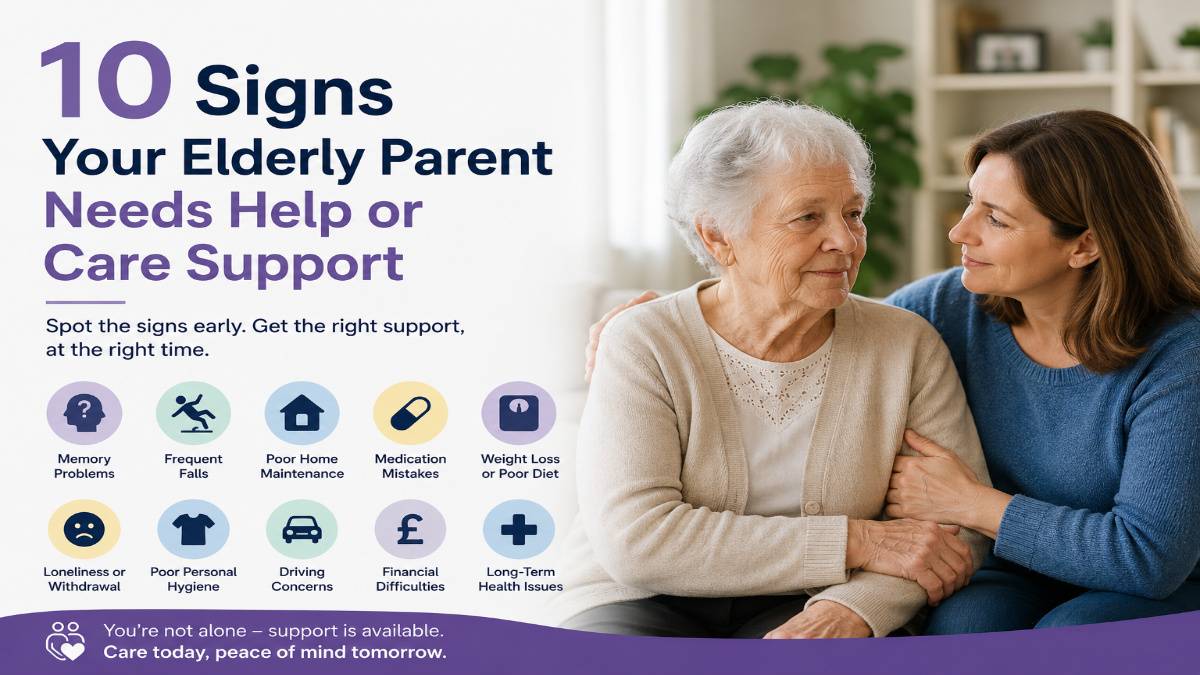
Understanding the signs your elderly parent needs help allows you to take action before daily life becomes unsafe or overwhelming.

Signs Your Elderly Parent Needs Help With Daily Living

Difficulty managing everyday tasks is often the first sign that extra support is needed.

Struggling with cooking and household tasks

A parent who once managed everything independently may begin:

  • Leaving dishes unwashed
  • Forgetting meals
  • Wearing unclean clothes
  • Ignoring household cleaning

These changes often suggest daily living is becoming harder to manage safely.

Also Read: What Is Residential Care?

Poor personal hygiene and self neglect

One of the clearest signs an elderly parent needs care support is a decline in personal hygiene.

Common signs include:

  • Body odour
  • Unwashed hair or clothes
  • Difficulty bathing
  • Neglected grooming

Missed medication and forgotten appointments

Medication mistakes are common when memory or routine starts to decline.

Signs include:

  • Unused tablets piling up
  • Taking the wrong dose
  • Missing GP or hospital appointments

At this stage, some families begin considering structured support through residential care homes UK or part-time care options.

Signs Your Elderly Parent Needs Dementia Care Support

Memory-related symptoms are one of the biggest reasons families begin exploring long term care.

Memory loss and repeated confusion

Occasional forgetfulness is normal. Repeated confusion is not.

Warning signs include:

  • Repeating the same questions
  • Forgetting familiar names
  • Getting lost in familiar places
  • Confusion about time or routine

These symptoms often lead families to explore dementia care homes UK that provide specialist memory support.

Behaviour and mood changes

Changes in mood can sometimes appear before a formal dementia diagnosis.

Common changes include:

  • Anxiety or agitation
  • Irritability
  • Withdrawal from family
  • Sudden personality changes

Signs Your Elderly Parent Needs Residential Care

As care needs increase, independent living may no longer be safe.

Increased falls and mobility problems

Falls are one of the most common reasons older adults lose independence.

Warning signs include:

  • Difficulty standing up
  • Holding furniture while walking
  • Poor balance
  • Unexplained bruises

When mobility problems increase, families often begin researching care homes UK that can provide safer daily support.

Isolation and withdrawal from social life

Older adults who stop seeing friends, attending activities, or leaving the house may be struggling physically or emotionally.

Loneliness can affect:

  • Mental wellbeing
  • Confidence
  • Physical health
  • Cognitive decline

Supportive environments in care homes in Widnes or care homes in Middlesbrough can help older adults regain social interaction and routine.

Poor nutrition and dehydration

Changes in eating and drinking habits are often overlooked.

Signs include:

  • Empty fridge or expired food
  • Sudden weight loss
  • Lack of appetite
  • Signs of dehydration or tiredness

According to the NHS, dehydration is more common in older adults and can increase confusion, weakness, and risk of falls.

Also Read: How to Pay for a Care Home in the UK

Signs Your Parent May Need More Than Home Support

You may need to consider residential care if:

  • Safety at home is becoming a concern
  • Daily support is needed throughout the day
  • Dementia symptoms are progressing
  • Family caregivers are overwhelmed

Many families begin by comparing local options such as:

Choosing nearby care allows regular visits and stronger family involvement.

Residential Care vs Nursing Care: What Is the Difference

Understanding the difference helps families choose the right support.

Residential care

  • Daily support and supervision
  • Help with washing, dressing, and meals
  • Suitable for mild to moderate care needs

Nursing care

  • Includes medical supervision
  • Suitable for complex health conditions
  • Managed by qualified nursing staff

Families needing medical support may explore services such as residential care homes UK.

FAQs About Signs an Elderly Parent Needs Help

Early signs include memory problems, poor hygiene, missed medication, falls, and difficulty managing daily tasks.

Frequent falls, confusion, self neglect, and medication mistakes are strong signs independent living may no longer be safe.

Residential care should be considered when support is needed throughout the day and safety becomes difficult to manage at home.

Residential care supports daily living, while dementia care includes specialist support for memory-related conditions and behavioural changes.

What Is Residential Care? Meaning, Services and When to Consider It in the UK

If you are trying to understand what residential care involves, you are probably in the middle of a decision that matters a great deal. Whether it is for a parent, a partner, or another family member, getting clear on what residential care actually means helps you move forward without second-guessing every step.

This guide covers what residential care is, what a care home provides day to day, how it compares to nursing care and home care, and what to look for when choosing.

What Is Residential Care?

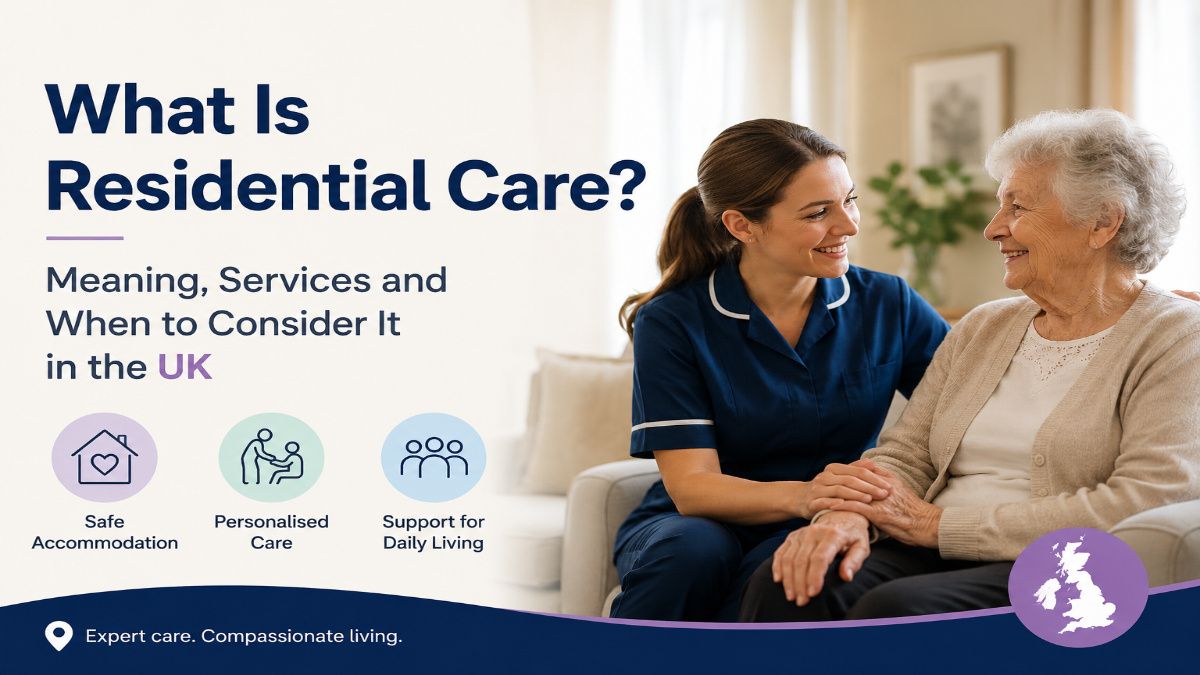
Residential care is a type of long-term support where a person moves into a registered care home and receives help with daily living on a full-time basis. Staff are on site around the clock to assist with personal care, meals, medication and social activities.

It is not a hospital. It is also not the same as home care, where a carer visits for a few hours each day. In a residential care home, the person lives there permanently and support is available at any hour, not just during scheduled visits.

In England, every residential care home must be registered with the Care Quality Commission (CQC), which carries out regular inspections and publishes ratings across five areas: safety, effectiveness, caring, responsiveness and leadership. In Wales the equivalent regulator is Care Inspectorate Wales. In Scotland it is the Care Inspectorate.

Also Read: What Is Dementia Care?

What Does a Residential Care Home Provide?

A well-run residential care home covers the practical and the personal. Day-to-day support typically includes the following.

Personal Care

Staff help with washing, dressing, grooming and moving around safely. This is provided in a way that respects each resident’s privacy and dignity at all times.

Meals and Nutrition

Three meals a day plus snacks, prepared on site. Most homes accommodate dietary requirements, allergies and personal food preferences.

Medication Support

Trained staff manage, prompt or administer medication in line with each resident’s care plan and GP instructions.

Social Activities

Group activities, outings, themed events and one-to-one time help residents stay engaged and reduce isolation. The specific programme varies between homes.

24-Hour Staffing

Care does not stop at 5pm. Staff are available through the night, which is particularly important for residents who experience confusion, disturbed sleep or mobility difficulties after dark.

Respite Care

Some residential homes also offer short-term stays. This can cover a recovery period after a hospital discharge or give a family carer a planned break. Stays can range from a few days to several weeks.

When Should You Consider Residential Care?

There is no single point at which residential care becomes the right answer. Families often start thinking about it when one or more of the following apply:

  • Daily tasks such as washing, dressing and preparing meals are becoming difficult or unsafe to manage alone
  • There have been falls, or the risk of falls at home is increasing
  • Dementia is progressing and the person needs supervision during the night as well as the day
  • A family carer’s own health, work or personal circumstances mean consistent care at home is no longer sustainable
  • The person is becoming isolated and the lack of social contact is visibly affecting their mood or health

Read this Also: Signs Your Elderly Parent Needs Help

A care needs assessment from the local council’s adult social care team is the correct formal starting point. This is a free assessment that determines what level of support is needed and whether the council will contribute to funding. A GP or hospital discharge team can make a referral, or you can contact your local council directly to request one.

How Much Does Residential Care Cost in the UK?

According to LaingBuisson’s 2024 Care of Older People UK Market Report, the average weekly cost of residential care in the UK sits at around £1,100. Costs vary by region. London and the South East tend to be higher. The North of England generally sits lower than the national average.

Funding is means-tested. In England, if a person’s assets including savings and property exceed £23,250, they are expected to fund their own care. Below that threshold the local council contributes based on an agreed personal budget. Thresholds differ in Wales, Scotland and Northern Ireland.

Some people qualify for NHS Continuing Healthcare funding if their primary need is health-related rather than social. An independent financial adviser who specialises in care funding can help clarify what applies before you commit to a placement.

Residential Care vs Nursing Care

The practical difference comes down to clinical input.

Residential Care

Provides personal support for daily living. Staff are trained carers. There is no requirement for a registered nurse to be on site.

Nursing Care

Provides the same personal support but also has registered nurses on site who manage wounds, complex medication regimes, catheter care and clinical monitoring. Nursing homes are the appropriate setting when a person’s health condition is complex, unstable or requires regular clinical oversight.

A care needs assessment will identify which setting is suitable. Some homes hold dual registration, meaning they provide both residential and nursing care under one roof. This allows a resident to remain in the same home if their needs change over time.

Check this Also: How to Pay for a Care Home in the UK

Residential Care vs Home Care

Home care, also called domiciliary care, involves a carer visiting the person at their own home at agreed times. It works well when someone needs help at specific points in the day but can otherwise manage safely between visits.

Residential care tends to be more appropriate when:

  • Support is needed during the night as well as the day
  • The home environment has safety risks that cannot reasonably be adapted
  • Multiple daily visits are already in place and are still not fully meeting the person’s needs
  • The level of social contact available at home is not sufficient for the person’s wellbeing

Many families start with home care and move into residential care as needs increase. There is no fixed rule about when that transition should happen. A care needs reassessment can help identify when home care is no longer meeting the required level of support.

What to Look for When Choosing a Residential Care Home

CQC inspection reports are publicly available at cqc.org.uk. A rating of Good or Outstanding across all five inspection areas is a reasonable starting point when comparing homes.

Beyond the rating, it is worth considering:

  • Whether the home has specific experience with the condition involved, particularly if dementia or a neurological condition is a factor
  • How the home handles changes in care needs and whether a resident can stay if their requirements increase
  • How the home communicates with families, including outside standard office hours
  • What the contract covers in terms of fee increases and what triggers a review of those fees
  • What daily life actually looks like in terms of activities, mealtimes and staff continuity

Visiting in person, ideally at different times of day, gives a more accurate picture than any brochure or website.

Care Homes Across the UK – Landona House Care Group

Landona House Care Group has been providing residential, dementia and nursing care since 2004. Our homes are registered with the CQC and located across the North West, North East and other parts of England.

If you are looking for a care home in a specific area, we have homes in the following locations:

  • Widnes, Cheshire — Ferndale Mews provides residential, dementia and nursing care in a purpose-built home on St Michaels Road.
  • Durham — Abbotts Court provides residential and dementia care in County Durham.
  • Warrington — Florence Mill offers residential, dementia and respite care in Warrington.
  • Middlesbrough — Tollesby Hall provides residential, dementia and nursing care in Middlesbrough.
  • Jarrow — Stapleton House offers residential, nursing and dementia care in South Tyneside.
  • Guisborough — Moorlands Nursing Home provides nursing and dementia care in Guisborough.
  • Runcorn — Beechcroft offers residential, dementia and respite care in Runcorn.
  • Bishop Auckland — Bishopsgate Lodge provides residential and dementia care in Bishop Auckland.
  • Cleveland — Hawthornes offers residential, dementia and respite care in Cleveland.

You do not need an appointment to visit any of our homes. Drop in, look around and speak with the team. View all our homes or get in touch if you would like to talk something through first.

FAQs About Residential Care

Residential care in the UK means living full time in a registered care home where staff provide support with daily activities, personal hygiene, meals, medication and social wellbeing. All homes in England are registered with and inspected by the Care Quality Commission.

A residential care home is a registered facility where adults who can no longer live independently receive round-the-clock personal support. Staff help with washing, dressing, meals and daily routines. Clinical nursing treatment is handled separately under nursing care.

Residential care covers personal support for daily living. Nursing care includes on-site registered nurses who manage complex medical conditions, wound care and clinical monitoring. A care needs assessment will identify which is appropriate for your situation.

According to LaingBuisson's 2024 Care of Older People UK Market Report, the average weekly cost is around £1,100. This varies by region and level of support required. Local councils fund eligible residents following a care needs assessment and means test.

Residential care suits adults who need regular support with daily living but do not require full-time clinical nursing. It is commonly chosen when someone can no longer manage safely at home, when dementia is progressing, or when family carers can no longer provide the level of support needed.

Respite care is a short-term stay in a residential care home, typically arranged while a family carer takes a break or while someone recovers after leaving hospital. Stays can range from a few days to several weeks depending on the situation.