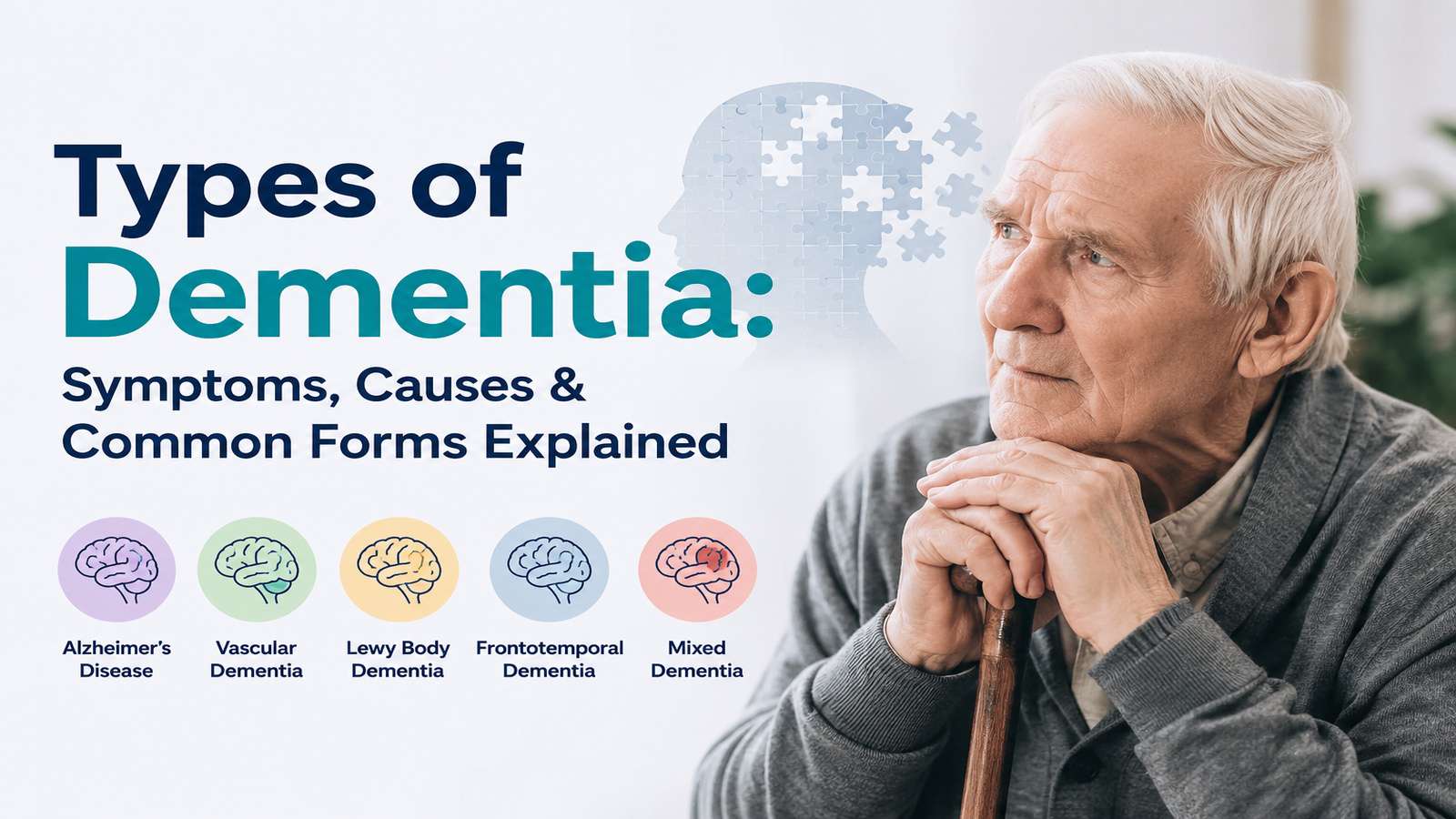
Dementia is not a single disease. It is a broad term used to describe a group of symptoms that affect memory, thinking, communication, behaviour and the ability to carry out everyday activities.
Many people assume dementia is simply another name for Alzheimer’s disease, but Alzheimer’s is just one of several different types of dementia. Each type affects the brain differently, can cause different symptoms and may progress at different rates.
Understanding the different forms of dementia can help individuals and families recognise symptoms earlier, seek appropriate medical advice and make informed decisions about future care and support.
What Is Dementia?
Dementia is an umbrella term for a collection of symptoms caused by damage to brain cells. These symptoms can affect:
- Memory
- Problem-solving abilities
- Language and communication
- Judgement and decision-making
- Mood and behaviour
- Spatial awareness
Dementia is not a normal part of ageing. While age is the biggest risk factor, dementia develops because of underlying conditions that affect the brain.
For many families, recognising the symptoms early is the first step towards obtaining a diagnosis and accessing support. If you are concerned about memory loss or behavioural changes, our guide to what dementia care is and how it helps provides useful information about support options available to individuals living with dementia.
How Many Types of Dementia Are There?
People often ask, “How many types of dementia are there?”
There are more than 100 conditions that can cause dementia symptoms. However, most diagnoses fall into four main categories:
| Main Type | Estimated Prevalence |
|---|---|
| Alzheimer’s disease | Most common |
| Vascular dementia | Second most common |
| Dementia with Lewy bodies | Common |
| Frontotemporal dementia | Less common |
Alongside these major forms, there are several other dementia types, including mixed dementia, Parkinson’s disease dementia and a number of rarer neurological conditions.
Some sources refer to the “12 types of dementia” when grouping together the most frequently diagnosed forms, but there is no universally accepted list of exactly 12 dementia types.
The 4 Main Types of Dementia
| Type of Dementia | Common Symptoms | Typical Age Group |
|---|---|---|
| Alzheimer’s disease | Memory loss, confusion, disorientation | Usually over 65 |
| Vascular dementia | Slower thinking, concentration difficulties, planning problems | Usually over 65 |
| Dementia with Lewy bodies | Hallucinations, movement issues, sleep disturbances | Usually over 65 |
| Frontotemporal dementia | Personality and behaviour changes, language difficulties | Often 45–65 |
These four conditions account for the majority of dementia diagnoses in the UK.
Alzheimer’s Disease
Alzheimer’s disease is the most common type of dementia, accounting for around two-thirds of dementia cases.
The condition develops when abnormal proteins build up in the brain, damaging nerve cells and disrupting communication between different areas of the brain.
Early Symptoms of Alzheimer’s Disease
Common early signs include:
- Forgetting recent conversations
- Misplacing items frequently
- Repeating questions
- Difficulty finding words
- Becoming confused about dates or locations
As Alzheimer’s progresses, symptoms become more severe and may affect mobility, communication and personal care.
Families often first notice subtle changes that can easily be mistaken for normal ageing. Learning about the early signs of dementia can help people identify potential concerns sooner and seek medical advice if necessary.
Vascular Dementia
Vascular dementia occurs when blood flow to the brain becomes reduced, often because of strokes or damage to blood vessels.
Unlike Alzheimer’s disease, memory loss is not always the first symptom.
Symptoms of Vascular Dementia
People may experience:
- Slower thinking
- Difficulty concentrating
- Problems with planning and organisation
- Reduced decision-making ability
- Mood changes
Symptoms can appear suddenly after a stroke or develop gradually over time.
Because vascular dementia is linked to cardiovascular health, managing blood pressure, diabetes and cholesterol can play an important role in reducing risk.
Dementia with Lewy Bodies
Dementia with Lewy bodies, often called Lewy body dementia, is caused by abnormal protein deposits known as Lewy bodies forming within the brain.
It shares characteristics with both Alzheimer’s disease and Parkinson’s disease.
Common Symptoms
People may experience:
- Visual hallucinations
- Fluctuating alertness
- Sleep disturbances
- Movement difficulties
- Muscle stiffness
- Balance problems
Symptoms can vary significantly from day to day, making diagnosis challenging in some cases.
Frontotemporal Dementia (FTD)
Frontotemporal dementia affects the frontal and temporal lobes of the brain.
Unlike Alzheimer’s disease, it often develops at a younger age and commonly affects people between 45 and 65.
Symptoms of Frontotemporal Dementia
Common symptoms include:
- Personality changes
- Socially inappropriate behaviour
- Loss of empathy
- Language difficulties
- Reduced motivation
- Impulsive actions
Frontotemporal dementia is sometimes referred to as frontal lobe dementia, and some forms were previously known as Pick’s disease.
Because symptoms often begin with behavioural changes rather than memory loss, diagnosis can sometimes be delayed.
Young-Onset Dementia
Young-onset dementia, also called early-onset dementia, refers to dementia diagnosed before the age of 65.
Although less common than later-life dementia, it can present unique challenges because individuals may still be working, raising families or managing financial commitments.
Several dementia types can occur as young-onset dementia, including:
- Alzheimer’s disease
- Frontotemporal dementia
- Vascular dementia
- Dementia with Lewy bodies
Early diagnosis can help families access specialist support and plan for future care needs.
Mixed Dementia
Mixed dementia occurs when a person has more than one dementia-related condition affecting the brain simultaneously.
The most common combination is:
- Alzheimer’s disease and vascular dementia
Because multiple conditions are involved, symptoms can vary widely between individuals.
Mixed dementia is increasingly recognised as one of the more common dementia diagnoses, particularly in older adults.
Parkinson’s Disease Dementia
Some people living with Parkinson’s disease later develop dementia symptoms.
Parkinson’s disease dementia can affect:
- Memory
- Attention
- Decision-making
- Visual processing
- Communication
Movement symptoms such as tremors and stiffness usually appear before cognitive symptoms develop.
While Parkinson’s disease dementia and dementia with Lewy bodies share similarities, they are classified differently based on when symptoms first appear.
Mild Cognitive Impairment (MCI): Is It Dementia?
Mild cognitive impairment (MCI) is not dementia.
People with MCI experience noticeable changes in memory or thinking, but these changes are not severe enough to significantly affect daily life.
Mild Cognitive Impairment vs Dementia
| Mild Cognitive Impairment | Dementia |
|---|---|
| Symptoms are mild | Symptoms interfere with daily activities |
| Greater independence maintained | Increased support often required |
| Not everyone progresses to dementia | Dementia symptoms generally worsen over time |
Some people with MCI eventually develop dementia, while others remain stable for many years.
Rarer Types of Dementia
Although less common, several rare neurological conditions can cause dementia symptoms.
Posterior Cortical Atrophy (PCA)
Affects visual processing and spatial awareness.
Corticobasal Syndrome (CBS)
Can cause movement difficulties alongside cognitive decline.
CADASIL
A rare inherited disorder affecting blood vessels in the brain.
Creutzfeldt-Jakob Disease (CJD)
A rapidly progressive neurological condition.
Progressive Supranuclear Palsy (PSP)
Affects balance, movement and cognition.
Huntington’s Disease
An inherited condition that can lead to dementia symptoms later in life.
These conditions are much less common than Alzheimer’s disease or vascular dementia but may require specialist diagnosis and support.
Which Type of Dementia Is Most Common?
Alzheimer’s disease is the most common type of dementia worldwide and in the UK.
It accounts for the majority of dementia diagnoses and is often what people think of when they hear the word dementia.
The most common dementia types are:
- Alzheimer’s disease
- Vascular dementia
- Dementia with Lewy bodies
- Frontotemporal dementia
- Mixed dementia
Understanding which type of dementia a person has can help guide treatment, support planning and long-term care decisions.
Do Different Types of Dementia Have Different Symptoms?
Yes. While there is overlap between dementia types, symptoms can vary considerably.
| Dementia Type | Key Symptoms |
|---|---|
| Alzheimer’s disease | Memory loss, confusion |
| Vascular dementia | Planning and concentration difficulties |
| Lewy body dementia | Hallucinations and movement issues |
| Frontotemporal dementia | Personality and behavioural changes |
| Parkinson’s disease dementia | Movement and cognitive difficulties |
Because symptoms differ, obtaining an accurate diagnosis is important.
When Should You Seek Medical Advice?
Occasional forgetfulness can be a normal part of ageing. However, persistent changes in memory, thinking, behaviour or communication should not be ignored.
Consider seeking medical advice if someone is:
- Frequently forgetting important information
- Becoming confused in familiar places
- Struggling with everyday tasks
- Experiencing significant personality changes
- Having difficulty communicating
Early diagnosis can provide access to treatment, support services and future care planning.
For families exploring long-term support options, specialist Dementia Care Homes in UK services can provide structured care, personalised support and safe environments designed around the needs of people living with dementia.
Supporting Someone Living With Dementia
Every person’s experience of dementia is unique. While symptoms and progression vary, timely support can make a significant difference to quality of life.
Whether someone is living independently, receiving support at home or considering residential care, understanding the type of dementia involved can help families make informed decisions about treatment, care planning and daily support.
As dementia progresses, some individuals may benefit from specialist residential care where trained staff can provide personalised assistance, structured routines and dementia-friendly environments tailored to changing needs.
FAQs About Types of Dementia
Find answers to common questions below
There are more than 100 conditions that can cause dementia symptoms, although most diagnoses fall into a smaller number of common dementia categories.
There are more than 100 conditions that can cause dementia symptoms, although most diagnoses fall into a smaller number of common dementia categories.
Alzheimer's disease is the most common type of dementia and accounts for the majority of dementia diagnoses.
Dementia is an umbrella term for symptoms affecting memory, thinking and behaviour. Alzheimer's disease is a specific condition and the most common cause of dementia.
Yes. This is known as mixed dementia, where more than one dementia-related condition affects the brain at the same time.
No. Mild cognitive impairment is not dementia, although some people with MCI may later develop dementia.