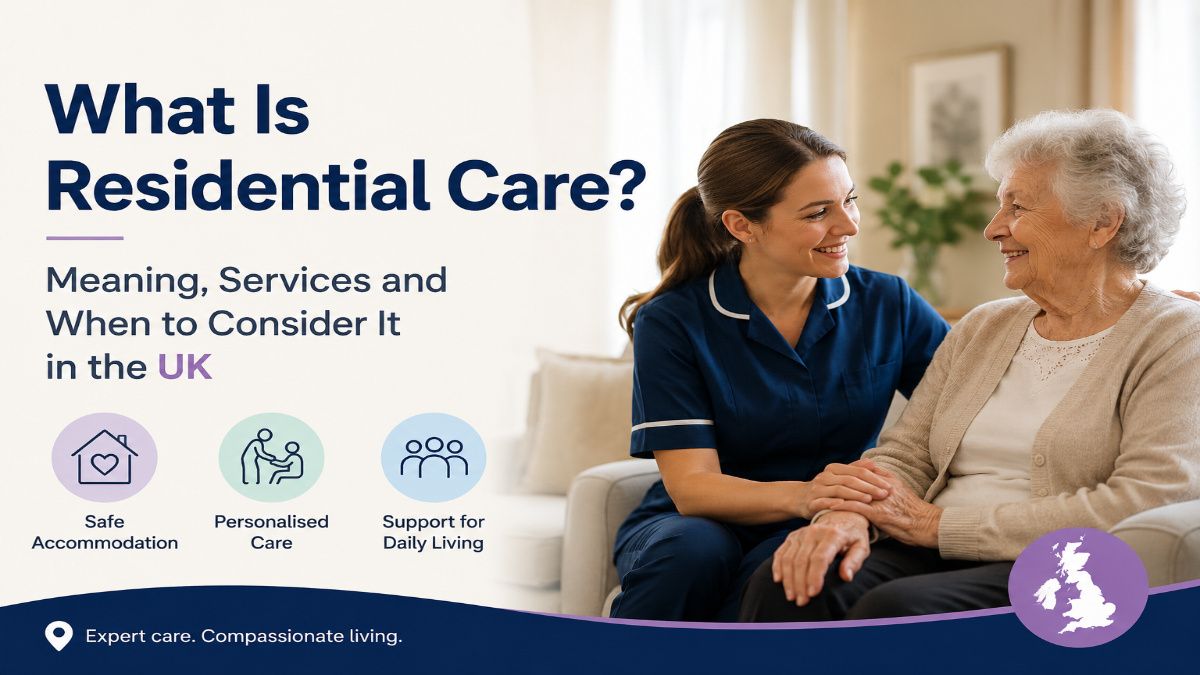
If you are trying to understand what residential care involves, you are probably in the middle of a decision that matters a great deal. Whether it is for a parent, a partner, or another family member, getting clear on what residential care actually means helps you move forward without second-guessing every step.
This guide covers what residential care is, what a care home provides day to day, how it compares to nursing care and home care, and what to look for when choosing.
What Is Residential Care?
Residential care is a type of long-term support where a person moves into a registered care home and receives help with daily living on a full-time basis. Staff are on site around the clock to assist with personal care, meals, medication and social activities.
It is not a hospital. It is also not the same as home care, where a carer visits for a few hours each day. In a residential care home, the person lives there permanently and support is available at any hour, not just during scheduled visits.
In England, every residential care home must be registered with the Care Quality Commission (CQC), which carries out regular inspections and publishes ratings across five areas: safety, effectiveness, caring, responsiveness and leadership. In Wales the equivalent regulator is Care Inspectorate Wales. In Scotland it is the Care Inspectorate.
Also Read: What Is Dementia Care?
What Does a Residential Care Home Provide?
A well-run residential care home covers the practical and the personal. Day-to-day support typically includes the following.
Personal Care
Staff help with washing, dressing, grooming and moving around safely. This is provided in a way that respects each resident’s privacy and dignity at all times.
Meals and Nutrition
Three meals a day plus snacks, prepared on site. Most homes accommodate dietary requirements, allergies and personal food preferences.
Medication Support
Trained staff manage, prompt or administer medication in line with each resident’s care plan and GP instructions.
Social Activities
Group activities, outings, themed events and one-to-one time help residents stay engaged and reduce isolation. The specific programme varies between homes.
24-Hour Staffing
Care does not stop at 5pm. Staff are available through the night, which is particularly important for residents who experience confusion, disturbed sleep or mobility difficulties after dark.
Respite Care
Some residential homes also offer short-term stays. This can cover a recovery period after a hospital discharge or give a family carer a planned break. Stays can range from a few days to several weeks.
When Should You Consider Residential Care?
There is no single point at which residential care becomes the right answer. Families often start thinking about it when one or more of the following apply:
- Daily tasks such as washing, dressing and preparing meals are becoming difficult or unsafe to manage alone
- There have been falls, or the risk of falls at home is increasing
- Dementia is progressing and the person needs supervision during the night as well as the day
- A family carer’s own health, work or personal circumstances mean consistent care at home is no longer sustainable
- The person is becoming isolated and the lack of social contact is visibly affecting their mood or health
Read this Also: Signs Your Elderly Parent Needs Help
A care needs assessment from the local council’s adult social care team is the correct formal starting point. This is a free assessment that determines what level of support is needed and whether the council will contribute to funding. A GP or hospital discharge team can make a referral, or you can contact your local council directly to request one.
How Much Does Residential Care Cost in the UK?
According to LaingBuisson’s 2024 Care of Older People UK Market Report, the average weekly cost of residential care in the UK sits at around £1,100. Costs vary by region. London and the South East tend to be higher. The North of England generally sits lower than the national average.
Funding is means-tested. In England, if a person’s assets including savings and property exceed £23,250, they are expected to fund their own care. Below that threshold the local council contributes based on an agreed personal budget. Thresholds differ in Wales, Scotland and Northern Ireland.
Some people qualify for NHS Continuing Healthcare funding if their primary need is health-related rather than social. An independent financial adviser who specialises in care funding can help clarify what applies before you commit to a placement.
Residential Care vs Nursing Care
The practical difference comes down to clinical input.
Residential Care
Provides personal support for daily living. Staff are trained carers. There is no requirement for a registered nurse to be on site.
Nursing Care
Provides the same personal support but also has registered nurses on site who manage wounds, complex medication regimes, catheter care and clinical monitoring. Nursing homes are the appropriate setting when a person’s health condition is complex, unstable or requires regular clinical oversight.
A care needs assessment will identify which setting is suitable. Some homes hold dual registration, meaning they provide both residential and nursing care under one roof. This allows a resident to remain in the same home if their needs change over time.
Check this Also: How to Pay for a Care Home in the UK
Residential Care vs Home Care
Home care, also called domiciliary care, involves a carer visiting the person at their own home at agreed times. It works well when someone needs help at specific points in the day but can otherwise manage safely between visits.
Residential care tends to be more appropriate when:
- Support is needed during the night as well as the day
- The home environment has safety risks that cannot reasonably be adapted
- Multiple daily visits are already in place and are still not fully meeting the person’s needs
- The level of social contact available at home is not sufficient for the person’s wellbeing
Many families start with home care and move into residential care as needs increase. There is no fixed rule about when that transition should happen. A care needs reassessment can help identify when home care is no longer meeting the required level of support.
What to Look for When Choosing a Residential Care Home
CQC inspection reports are publicly available at cqc.org.uk. A rating of Good or Outstanding across all five inspection areas is a reasonable starting point when comparing homes.
Beyond the rating, it is worth considering:
- Whether the home has specific experience with the condition involved, particularly if dementia or a neurological condition is a factor
- How the home handles changes in care needs and whether a resident can stay if their requirements increase
- How the home communicates with families, including outside standard office hours
- What the contract covers in terms of fee increases and what triggers a review of those fees
- What daily life actually looks like in terms of activities, mealtimes and staff continuity
Visiting in person, ideally at different times of day, gives a more accurate picture than any brochure or website.
Care Homes Across the UK – Landona House Care Group
Landona House Care Group has been providing residential, dementia and nursing care since 2004. Our homes are registered with the CQC and located across the North West, North East and other parts of England.
If you are looking for a care home in a specific area, we have homes in the following locations:
- Widnes, Cheshire — Ferndale Mews provides residential, dementia and nursing care in a purpose-built home on St Michaels Road.
- Durham — Abbotts Court provides residential and dementia care in County Durham.
- Warrington — Florence Mill offers residential, dementia and respite care in Warrington.
- Middlesbrough — Tollesby Hall provides residential, dementia and nursing care in Middlesbrough.
- Jarrow — Stapleton House offers residential, nursing and dementia care in South Tyneside.
- Guisborough — Moorlands Nursing Home provides nursing and dementia care in Guisborough.
- Runcorn — Beechcroft offers residential, dementia and respite care in Runcorn.
- Bishop Auckland — Bishopsgate Lodge provides residential and dementia care in Bishop Auckland.
- Cleveland — Hawthornes offers residential, dementia and respite care in Cleveland.
You do not need an appointment to visit any of our homes. Drop in, look around and speak with the team. View all our homes or get in touch if you would like to talk something through first.
FAQs About Residential Care
Residential care in the UK means living full time in a registered care home where staff provide support with daily activities, personal hygiene, meals, medication and social wellbeing. All homes in England are registered with and inspected by the Care Quality Commission.
A residential care home is a registered facility where adults who can no longer live independently receive round-the-clock personal support. Staff help with washing, dressing, meals and daily routines. Clinical nursing treatment is handled separately under nursing care.
Residential care covers personal support for daily living. Nursing care includes on-site registered nurses who manage complex medical conditions, wound care and clinical monitoring. A care needs assessment will identify which is appropriate for your situation.
According to LaingBuisson's 2024 Care of Older People UK Market Report, the average weekly cost is around £1,100. This varies by region and level of support required. Local councils fund eligible residents following a care needs assessment and means test.
Residential care suits adults who need regular support with daily living but do not require full-time clinical nursing. It is commonly chosen when someone can no longer manage safely at home, when dementia is progressing, or when family carers can no longer provide the level of support needed.
Respite care is a short-term stay in a residential care home, typically arranged while a family carer takes a break or while someone recovers after leaving hospital. Stays can range from a few days to several weeks depending on the situation.