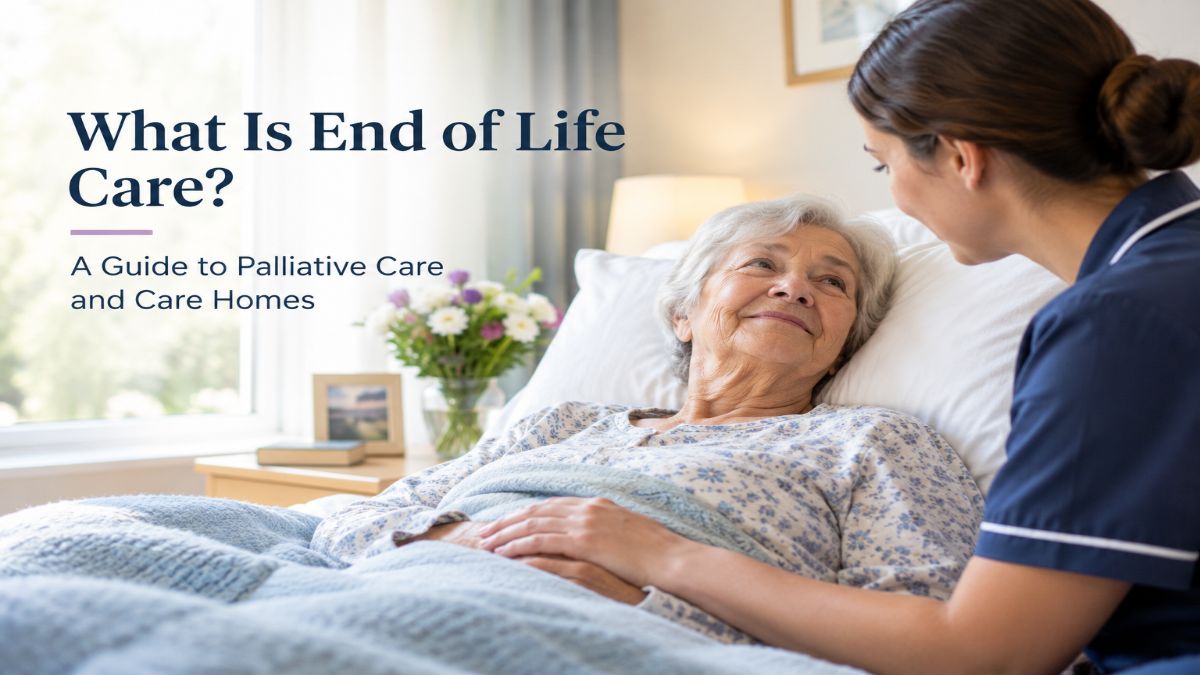
End of life care supports a person during the later stages of their life, helping them remain as comfortable, dignified and involved in decisions about their care as possible. It can include support with physical symptoms, personal care, emotional wellbeing and practical needs, as well as support for family members and carers.
End of life care can take place in different settings, including a care home, at home, in a hospice or in hospital. The right setting depends on the person’s condition, wishes, care needs and the support available.
It is also closely connected with palliative care, but the two terms do not mean exactly the same thing.
What Is End of Life Care?
End of life care is care and support for people who are approaching the end of their life. In the UK, this can include people who are likely to be in the last 12 months of life, although predicting exactly how long someone has left is not always possible.
The purpose is not simply to treat a person’s medical condition. Good end of life care considers the whole person and aims to help them live as well as possible for as long as possible, while maintaining comfort, dignity and choice.
Depending on the person’s circumstances, end of life care may involve:
- managing pain and other symptoms
- help with washing, dressing, eating and other personal care
- emotional and psychological support
- practical support
- maintaining familiar routines where possible
- discussing the person’s wishes and preferences
- involving family members and carers in care planning
- coordinating care between different health and social care professionals
The level of support can change as a person’s condition changes. Someone may need relatively little additional support at first, followed by more intensive care as their needs increase.
Check: Types of Dementia
What Does End of Life Care Involve?
End of life care is different for every person. A care plan should reflect the individual’s condition, preferences, communication needs, routines and priorities rather than following a standard approach.
Managing pain and other symptoms
Pain is only one possible symptom. Depending on the person’s illness, they may also experience breathlessness, nausea, tiredness, anxiety or other symptoms.
Care teams can monitor changing symptoms and work with relevant healthcare professionals to ensure appropriate support is provided.
The aim is to reduce distress and maintain comfort rather than simply focusing on treating the underlying illness.
Personal care and comfort
As someone’s health changes, they may need more help with everyday activities such as washing, dressing, eating, drinking or moving around.
Personal care should be delivered with sensitivity and respect for the person’s privacy. Small details can become increasingly important, including preferred routines, clothing, food, room environment and how the person likes to be supported.
Emotional and psychological support
Approaching the end of life can bring difficult emotions for the person and those close to them.
People may experience fear, anxiety, sadness, frustration or uncertainty. Some may want to talk openly about what is happening, while others may prefer to focus on familiar activities and relationships.
Good care should respond to the person’s preferences rather than assuming everyone will cope in the same way.
Support for family and carers
End of life care also affects family members and informal carers.
Families may need information about changes in the person’s condition, help understanding care decisions or reassurance about what to expect. Where appropriate, relatives can be involved in discussions about care and the person’s wishes.
Maintaining dignity, choice and familiar routines
Comfort is not only about physical symptoms.
Maintaining dignity, privacy, personal choice and familiar routines can make a significant difference to someone’s experience of end of life care. NHS guidance also emphasises discussing a person’s wishes and preferences as part of planning their care.
Also Check: The Later Stage of Dementia
What Is Palliative Care?
Palliative care is an approach to care for people living with a life-limiting or life-threatening illness. Its focus is on improving quality of life by managing symptoms and providing appropriate physical, emotional, social, psychological and practical support.
Palliative care does not necessarily begin when someone is in the final days or weeks of life.
A person can receive palliative care after being diagnosed with an incurable illness and may continue to receive other treatments at the same time. Some people receive palliative care for a considerable period before they require end of life care.
The term terminal care is sometimes used when talking about care during the final stage of a person’s life. However, palliative care is broader and can begin much earlier.
What Is the Difference Between Palliative Care and End of Life Care?
Palliative care and end of life care overlap, but they are not interchangeable terms.
| Palliative care | End of life care |
|---|---|
| Can begin earlier during a life-limiting illness | Usually relates to the later stage of life |
| Can continue for months or years | May last days, months or sometimes longer |
| Focuses strongly on quality of life and symptom management | Focuses on comfort, dignity, choice and support as someone approaches death |
| Can be provided alongside other treatments | Forms part of the person’s care during the final stage of life |
| Can involve general or specialist healthcare professionals | Can involve health and social care professionals, care staff, family and carers |
In simple terms, end of life care can be considered a form of palliative care provided when someone is approaching the end of their life.
This distinction matters because receiving palliative care does not automatically mean that a person is dying imminently.
Also Check: 10 Signs Your Elderly Parent Needs Help or Care Support
Does Palliative Care Mean Someone Is Dying?
No. Receiving palliative care does not necessarily mean that someone is in the final days or weeks of life.
Palliative care can be introduced when someone has a life-limiting illness, sometimes while they are still receiving treatment intended to manage the illness or extend life.
For example, someone with a progressive illness may receive palliative support to manage pain, breathlessness or other symptoms while continuing with other aspects of their treatment.
End of life care is more specifically concerned with the later stage of life, when a person is approaching death.
It is therefore possible for someone to receive palliative care without being at the immediate end of their life.
How Long Does End of Life Care Last?
There is no fixed answer to how long end of life care lasts.
Every person’s circumstances are different, and it can be difficult for healthcare professionals to predict exactly how long someone has left. NHS guidance states that end of life care may last for a few days or months, and sometimes more than a year.
The length of care can depend on:
- the person’s underlying illness
- how quickly their condition is progressing
- other health conditions
- their level of frailty
- changes in symptoms
- the level of support they need
This is why end of life care should be reviewed as the person’s needs change rather than being based on a fixed timetable.
A person may need increasing support with mobility, medication, nutrition, personal care or symptom management. Their care plan may therefore need to be adjusted over time.
How Long Does Palliative Care Last?
Palliative care can last for very different lengths of time.
Unlike end of life care, palliative care does not necessarily begin during the final stage of someone’s life. It can start earlier after a person develops a life-limiting illness and continue alongside other forms of treatment.
Some people may receive palliative support for months or years, while others may only need it for a shorter period.
The important consideration is whether the person’s needs are being identified and supported as their condition changes.
End of Life Care in a Care Home
For some people, a care home can provide a stable environment where they can receive ongoing support as their care needs become more complex.
End of life care in care homes may involve support from care staff and nurses, alongside GPs, community nurses and other healthcare professionals where required. NHS guidance confirms that end of life care can be provided in some care homes where trained staff are available to provide day and night support.
A care home may be particularly relevant when a person’s needs have become difficult to manage safely at home or when they require regular support with everyday activities and clinical needs.
What support can a care home provide?
Depending on the care home’s facilities, staffing and registered services, support may include:
- personal care
- assistance with mobility
- nutrition and hydration support
- medication support
- monitoring of changing care needs
- nursing care where available
- emotional and social support
- communication with healthcare professionals
- involvement of family members in care planning
The exact level of support varies between care homes, so families should always ask about the specific care available at the home they are considering.
What should families ask a care home about end of life care?
If someone may eventually need end of life care, it is sensible to discuss this before making a decision about a care home.
Questions to ask include:
- Does the home have experience supporting people at the end of life?
- What nursing support is available?
- How are changes in symptoms identified and managed?
- How does the home work with GPs, district nurses and other healthcare professionals?
- How are relatives kept informed about changes in care?
- How are the person’s wishes and preferences recorded?
- Can family members spend time with the resident when their condition changes?
- What happens if the person’s nursing or personal care needs increase?
These questions can help families understand whether the home is suitable not only for someone’s current needs, but also for the possibility of changing needs in the future.
How care needs can change over time
Someone entering a care home may initially need support mainly with daily activities, mobility or medication. Their requirements may later change as their health deteriorates.
This is why individual care planning and regular reviews are important.
The aim is to recognise changing needs and involve the appropriate professionals and family members when decisions need to be made.
What Should You Ask a Care Home About Palliative and End of Life Care?
When comparing care homes, it is easy to focus on bedrooms, facilities, location and activities. These are important, but families should also look at how the home would respond if care needs become more complex.
Ask the care team:
Who will coordinate the person’s care?
Find out how the home works with GPs, community nurses and other healthcare professionals.
What happens when symptoms change?
Ask how staff recognise deterioration and what happens if someone needs additional clinical support.
How is the person’s care plan updated?
A person’s wishes and needs can change, so ask how these changes are documented and communicated.
How are families involved?
Good communication can help relatives understand changes and participate in decisions where appropriate.
Can the home support increasing nursing needs?
If the person’s health is likely to become more complex, find out what nursing provision is available and when additional healthcare support would be involved.
How does the home protect dignity and privacy?
Ask about personal care, private space, routines and how individual preferences are respected.
The answers can tell you more about the home’s approach than a list of facilities alone.
End of Life Care for Someone With Dementia
End of life care for someone living with dementia can require particular attention because the person may have difficulty communicating pain, discomfort or changes in how they feel.
Their needs may also change as dementia progresses.
Care may therefore need to focus on:
- recognising changes in behaviour or communication
- maintaining familiar routines where possible
- supporting personal care
- monitoring nutrition and hydration
- maintaining comfort
- involving people who know the person well
- respecting previously expressed wishes and preferences
- working with healthcare professionals when needs change
Familiar surroundings and consistent approaches can also become particularly important for someone living with dementia.
Landona House Care Group’s dementia-care information describes a person-centred approach that includes familiar environments, individual routines and emotional support for residents and families.
Families considering dementia care can also benefit from understanding how a care home manages changing needs rather than looking only at the initial level of support required.
Where Can Someone Receive End of Life Care?
End of life care is not limited to one setting. The appropriate option depends on the person’s medical needs, preferences and the support available.
In a care home
Some care homes have trained staff who can support residents day and night, with healthcare professionals involved according to the person’s needs.
For someone already living in a care home, continuing care there may help avoid an unnecessary move when their needs change, provided the home can safely meet those needs.
At home
Some people prefer to remain in familiar surroundings.
End of life care can sometimes be provided at home, with support from healthcare and community services. The availability of services depends on local arrangements and the person’s needs.
Families should speak with the person’s GP or healthcare team about what support can be arranged.
In a hospice
Hospices provide specialist support for people with incurable illnesses and can help with medical, emotional, practical, psychological and social needs. Hospice care may be provided for different periods depending on the person’s circumstances and does not necessarily mean staying there continuously.
In hospital
Hospital care may be appropriate when someone needs medical assessment or treatment that cannot be safely provided elsewhere.
Many hospitals also have specialist palliative care teams that work alongside doctors, nurses and other healthcare professionals.
Who Provides End of Life Care?
End of life care is usually provided by more than one person or organisation.
Depending on the person’s needs, the team may include:
- care home staff
- registered nurses
- GPs
- community or district nurses
- hospital doctors and nurses
- specialist palliative care professionals
- therapists
- social care professionals
- family members and informal carers
The NHS notes that different health and social care professionals can be involved depending on the person’s individual circumstances.
Good coordination matters because a person’s needs can change quickly, particularly during the later stages of life.
How to Choose the Right Care Setting for End of Life Care
There is no single care setting that is right for everyone.
When comparing options, consider the person’s current needs as well as what may be needed if their condition changes.
Look at:
- Level of care: Does the setting provide the level of personal and nursing support required?
- Changing needs: Can the care plan be reviewed as the person’s condition changes?
- Healthcare support: How does the setting work with GPs, nurses and other healthcare professionals?
- Dementia experience: Is appropriate support available if the person is living with dementia?
- Communication: How are families kept informed?
- Personal wishes: How are individual choices, routines and preferences recorded?
- Dignity and privacy: Does the environment allow the person to receive personal care respectfully?
- Family involvement: Can relatives remain involved and spend meaningful time with the person?
- Continuity: Will the person have familiar staff and surroundings where possible?
A visit can also be useful. Ask the care team how they would respond to a realistic change in the person’s needs rather than only asking what services are listed on the website.
Nursing care as a related care option
For people with more complex medical needs, nursing care may be one of the options families need to consider.
Landona House Care Group states that its nursing care includes 24-hour clinical support from qualified nurses, ongoing clinical assessments and monitoring, medication management, support for long-term and complex needs, and end-of-life and palliative care. It also states that its nursing care works in partnership with healthcare professionals.
This does not mean that every individual care home should be assumed to provide the same level of end of life support. Families should check the services, staffing and suitability of the specific home they are considering.
FAQs: What Is End of Life Care
Find answers to common questions below
End of life care is support for someone approaching the end of their life. It aims to maintain comfort, dignity and quality of life while also supporting the person's family and carers. It can include physical, emotional, practical and personal care.
There is no fixed timeframe. End of life care may last for days or months and, in some circumstances, longer. The duration depends on the person's condition and how their needs change.
Not necessarily. Palliative care can begin earlier in a life-limiting illness and may continue alongside other treatments. End of life care is more specifically associated with the later stage of life.
Yes. Palliative and end of life care can be provided in some care homes, depending on the home's staffing, facilities and registered services. Healthcare professionals may also be involved as the person's needs require.